The update | 8 September 2026
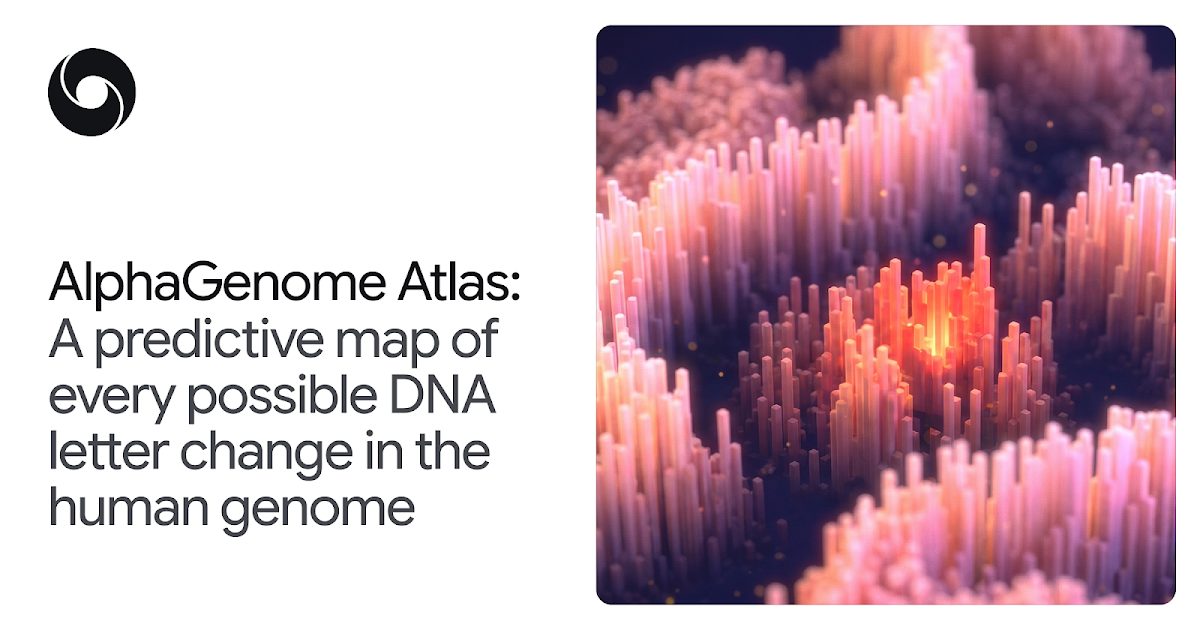
Google DeepMind introduced AlphaGenome Atlas, a resource containing predicted molecular effects for nine billion possible single-letter changes in the human genome. The team describes a free portal for academic research and a dataset of about one petabyte. The key word is predicted: the catalogue is not nine billion completed laboratory experiments. [5]
History and scientific function
The original AlphaGenome model was described in a Nature paper published in January 2026. It reads long DNA sequences and predicts features such as gene expression, splicing and chromatin properties. The researchers report matching or exceeding leading external models in 25 of 26 variant-effect evaluations. That result concerns selected benchmarks; it is not a universal clinical accuracy score. [6]
Why the distinction matters
Knowing the sequence of DNA does not automatically tell a scientist what each change will do. AI can help rank plausible variants and suggest mechanisms. Researchers can then spend experimental time on a smaller set of candidates. A prioritisation tool therefore complements evidence gathering rather than removing it.
Statement from the research team
The AlphaGenome Atlas team says external collaborators have used the resource to identify and experimentally verify important variants in unresolved rare-disease research. This is an attributed institutional statement, not a claim that every entry has been validated. [5]
Benefits and boundaries
The Atlas adds an impact score that combines predictions from AlphaGenome and AlphaMissense to help researchers rank variants. [5] The underlying Nature paper also identifies limitations: human and mouse coverage, difficult cell-specific predictions and a lack of personal-genome benchmarking in that study. [6] These boundaries matter when interpreting results.
TANEVOR view
This is a strong example of science and technology working together: computation can make a difficult research question more manageable. For Nigerian students and research teams, the immediate opportunity is learning bioinformatics, reproducible analysis and careful interpretation. A striking AI output is a starting point for investigation, not a diagnosis or proof of a cure.
What readers should watch
Look for independent replication and experimentally confirmed findings. Judge progress by what researchers validate and explain, as well as dataset size.
EXPLAINER
Reading DNA is not the same as explaining it
A DNA sequence can be thought of as biological information written in a long chain of letters. Finding a change in that sequence is one step; understanding what it alters is another. This is the interpretation problem addressed by AlphaGenome.

Sequence, activity and effect
A genetic change may affect a protein-coding instruction or a region involved in regulating gene activity. Scientists therefore investigate more than the presence of a variant. They ask whether it changes molecular behaviour and how that behaviour relates to a broader biological question. The Nature paper covers predictions across several molecular modalities. [6]
Why context matters
Biology depends on context, including the cell or tissue being studied. A useful prediction in one setting is not automatically a reliable explanation in another. The AlphaGenome researchers identify difficult cell-specific predictions and limitations in their evaluation coverage. Those details help users understand where further testing remains necessary. [6]
What an atlas contributes
A precomputed catalogue allows researchers to explore predictions without starting every analysis from scratch. AlphaGenome Atlas combines predicted effects with an impact score that helps prioritise variants. [5] An atlas makes information easier to search and compare; it does not turn a prediction into an observed fact.
How to read a strong science story
Separate the question, the method, the measured result and the interpretation. A benchmark comparison, a validated experimental finding and a suggested future application answer different questions. Our view is to explain those differences so that readers can appreciate progress without confusing it with a finished clinical solution.
PRACTICAL GUIDE
From prediction to a research result
The following research sequence is illustrative. It shows how computational predictions and laboratory work can complement one another. It is not a patient case or a record of work conducted by TANEVOR.
Define a focused question
A team might investigate whether a particular DNA change affects the activity of a gene in a chosen experimental context. The question should specify what change is being tested and what outcome would count as supporting or contradicting the proposed explanation.
Use AI to prioritise candidates
Researchers can compare predictions for candidate variants and choose which to investigate first. They should retain the model version, settings, input and scoring method so that another person can understand the analysis. A high impact score is a reason to investigate; it is not an automatic statement that a variant causes disease.
Design an independent check
The laboratory stage should test a relevant molecular outcome with appropriate comparison conditions. Researchers then compare the observation with the prediction. Agreement can support a particular mechanism; disagreement is also informative and may expose a modelling limit or a problem with the original hypothesis.
Explain the practical significance
When communicating the result, distinguish what was measured from what is inferred. State the setting, sample or experimental constraints. A result in one model system may need further investigation before wider use. The Atlas team reports experimentally verified findings from collaborators, while the catalogue as a whole remains a resource of predictions. [5]
Sources & further reading
Research checked for this issue on 5 October 2026. Publication dates refer to the source; practical examples are labelled in the text.
- Google DeepMind / AlphaGenome Atlas team
A predictive map of every possible DNA letter change in the human genome ↗
8 September 2026 - Avsec and colleagues / Nature
Advancing regulatory variant effect prediction with AlphaGenome ↗
28 January 2026; DOI: 10.1038/s41586-025-10014-0
Work photographs are representative examples of the activity described. They are not evidence of a specific TANEVOR, NVIDIA, FAO or BRIDGE project. Product photographs show the model identified in their captions.